
Shipyard design teams reach a point where machinery foundations and connection details must stop changing. An electrical machine specified after that stage can disrupt the agreed engine-room arrangement. A custom ship alternator request belongs earlier, while engine interfaces, space, and vessel requirements remain open for coordination.
A standard marine alternator may satisfy the design. The shipyard first locates any mismatch with the catalogue configuration and defines the custom work around its effect on the installation. That work enters the design schedule before freeze, while interfaces remain open for coordination with the engine supplier and project approval team.
Exposure and Motion Define the Design Envelope
Salt-laden air can reach equipment that is already exposed to engine vibration and vessel motion. Humidity and salt deposits challenge insulation and metal surfaces, while mechanical movement imposes different stresses on the assembly. The installation faces interacting environmental conditions, despite an electrical load resembling that of a shore-based facility.
A marine alternator needs a mounting and connection arrangement compatible with the vessel’s inclination, rolling, and vibration conditions. Rotor balance addresses a source of internal vibration, but does not remove vibration transmitted from the prime mover or supporting structure. Shaft alignment and the complete machinery combination remain relevant to the mechanical assessment.
Salt can reach vulnerable winding materials inside a ship alternator, putting its internal protection under stress. Moisture-resistant treatment addresses vulnerable materials, while the enclosure specification concerns exposure at the machine boundary. Customization is relevant where the required combination is unavailable in the standard configuration, with cooling provisions retained alongside protection.
Class Requirements Enter Before Production
The vessel’s selected classification framework governs what the engineering team needs to submit for review. CCS, ABS, and DNV requirements belong to particular project approval routes, rather than a single interchangeable label. The applicable rules and requested evidence need to be identified while equipment specifications and installation details are still being developed.
A marine alternator specification can translate that framework into relevant electrical, environmental, and construction requirements. The protection arrangement, winding treatment, and proposed operating conditions then have a defined role in the design review. General conformity with a rotating-machine standard does not establish every approval needed for a vessel.
The supplied ship alternator must correspond to the equipment covered by the relevant approval documents. Custom changes may alter the configuration being reviewed, making coordination with the supplier and project approval team necessary. Certificate scope, inspection requirements, and installation acceptance are connected tasks; an approval for another model cannot settle them.
Bearing Arrangement Connects Layout to the Prime Mover
The drive-end connection determines how the electrical machine joins the engine and occupies the machinery space. Bearing arrangement is part of that connection, alongside flange dimensions and the coupling structure. A late change to these details can affect an assembly that the shipyard has already incorporated into foundations and surrounding equipment routes.
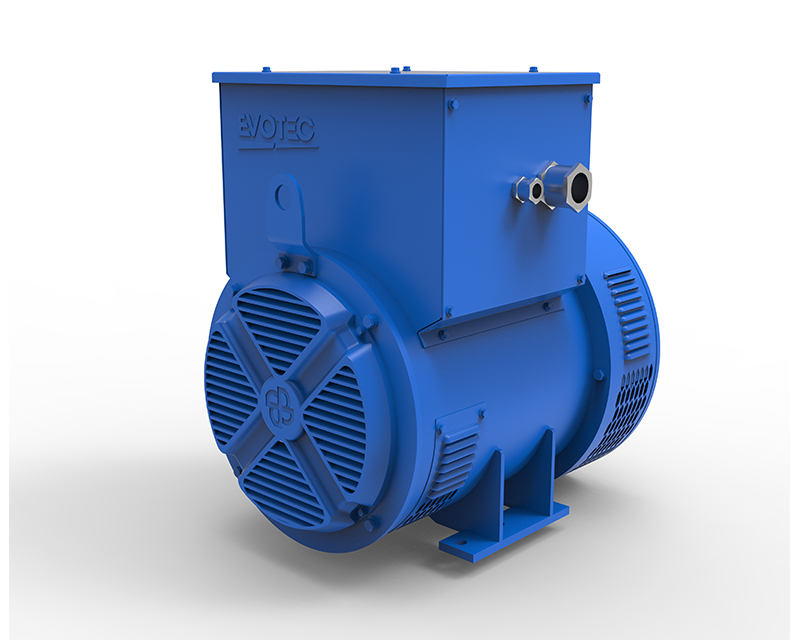
EvoTec Power‘s TCU platform makes this mechanical choice explicit through single- and double-bearing structures. Its single-bearing arrangement connects to the prime mover through a drive-end flange and flexible disc. The double-bearing arrangement has end shields at both ends. These structures provide different starting points for coordinating the engine and electrical end.
The platform’s rotors undergo high-speed dynamic balancing, with half-key balancing used for double-bearing machines. Such manufacturing measures address rotor behavior within the chosen structure. The marine alternator installation still requires the coupling and support arrangement to agree with the engine’s interfaces, so mechanical coordination continues beyond selecting a bearing count.
Restricted machinery-space length can prevent the proposed assembly from accommodating a full-length ship alternator. EvoTec Power customizes alternators for power, voltage and frequency requirements, using compact structures to address restricted installation space. The resulting layout must still reserve ventilation routes, cable access, and room for service, before adjacent equipment positions are fixed.
Set the Boundary Between Options and Redesign
A monitoring accessory does not require a new electromagnetic or mechanical design merely because it appears on an option list. The TCM228 marine alternator family has standard IP23 protection and Class H insulation. Available choices include PT100 winding and bearing detectors, PTC winding protection, and accessories for paralleling or manual voltage adjustment.
EvoTec Power also lists a separate IP55 customized family with winding and bearing monitoring options and specified marine varnish provisions. Adding temperature detectors to a TCM228 machine does not assign it the protection rating of another design or establish a different enclosure arrangement.
A custom ship alternator becomes necessary when the vessel needs a changed electrical point, mechanical package, or protection arrangement that available options cannot supply. The engineering request then defines the departure from catalogue equipment. Separating accessory selection from redesign keeps the design effort focused on the interface or environmental requirement that needs resolution.
Resolve the Interfaces Before Design Freeze
Design freeze gives the shipyard a practical deadline for settling the chosen marine alternator within the vessel’s machinery arrangement. Custom work on the ship alternator follows the documented catalogue mismatch, with the relevant approval route carried into the equipment review. Agreed connection details and reserved space prevent unresolved component choices from passing into the released installation layout.