
Selecting access equipment for an indoor construction or maintenance project involves more than reaching the required working height. Floor loading is equally important, particularly in commercial buildings, warehouses, manufacturing facilities, and renovation projects where slab capacity may be limited. For contractors, equipment rental companies, and facility managers, understanding how a lift distributes its weight helps reduce structural risks, improve site planning, and avoid costly delays.
An electric scissor lift offers quiet, emission-free operation for many indoor applications, but its suitability depends on both machine specifications and site conditions. Before choosing a model, project teams should assess the floor structure, equipment weight, wheel loads, travel routes, and intended working activities.
What Floor Loading Means for Scissor Lift Operations
Floor loading describes the forces a machine transfers to the surface supporting it. A lift’s total weight is only one part of the assessment. Its load distribution, wheel contact areas, operating position, and movement can also affect how forces reach the floor structure.
A concrete slab that supports stationary storage equipment may not automatically be suitable for a mobile elevated platform. Concentrated wheel loads can create localized stresses, while joints, cracks, suspended slabs, and underground service areas may introduce additional concerns. Site teams should therefore confirm structural capacity instead of judging suitability from the floor’s visible condition.
Why Machine Weight Is Only the Starting Point
The equipment’s gross weight provides an initial reference, but it does not describe every force acting on the floor. Wheel loads depend on the machine’s design and load distribution, while workers, tools, and materials add weight within the platform’s rated capacity. Movement, turning, and changes in operating conditions can also influence the loads transferred to individual wheels.
Contractors should obtain manufacturer data on machine weight, wheel loads, and ground-bearing pressure where available. These figures should be reviewed alongside the building’s structural drawings and any restrictions established by a qualified structural engineer. Generic weight estimates or assumptions based on similar machines are not substitutes for model-specific information.
Assessing the Floor Before Selecting an Electric Scissor Lift
A reliable selection process starts with a survey of the work area. Project managers should identify whether the lift will operate on a ground-supported slab, an elevated concrete floor, a mezzanine, or another structural surface. Each situation may have different load limits and reinforcement details.
The survey should also identify floor openings, trenches, expansion joints, ramps, uneven surfaces, and areas above basements or utility spaces. Construction drawings may provide useful information, but the building’s current condition and any subsequent alterations should be considered. When capacity is uncertain, a qualified professional should evaluate the proposed equipment and operating conditions before use.
Route planning matters just as much as the final working position. A machine may need to pass through narrow access points or travel across several floor sections before reaching its destination. Mapping these routes in advance helps teams identify restricted areas, avoid unsuitable surfaces, and coordinate equipment delivery with other site activities.
Matching a 25 Foot Scissor Lift to Site Requirements
Working height should be considered alongside structural limitations, rather than treated as the sole selection criterion. A 25 foot scissor lift may suit certain overhead installation, electrical maintenance, and interior finishing tasks, but the required platform height and actual working height are different measurements. Buyers should check the manufacturer’s definitions before comparing models.
A compact machine can help with access through confined indoor spaces, yet a smaller footprint does not automatically mean lower floor loading. Procurement teams should compare gross weight, wheel-load information, platform capacity, dimensions, and operating restrictions. The best choice is the model that meets the task’s reach requirements while remaining compatible with verified site conditions.
Applying the Principles to Zoomlion Access Equipment
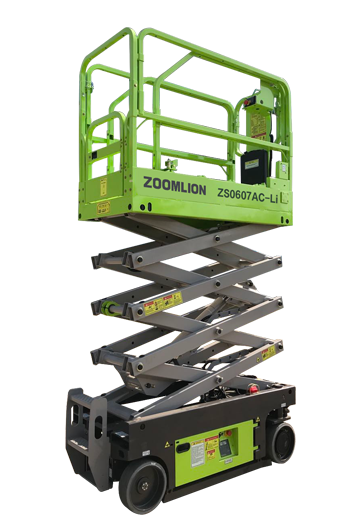
The Zoomlion Access ZS0607AC-Li provides a practical example of why specifications should be reviewed together. The model has a maximum working height of 7.8 m indoors and 6.4 m outdoors, a platform capacity of 230 kg, and a gross weight of 1,455 kg. Its compact overall width is 0.76 m, supporting access planning in confined work areas.
The model also features an AC drive system, IP67-rated waterproof protection for its AC wheel motors, and lithium-ion batteries. Zoomlion states that the battery system increases running time by 30% and can operate in temperatures down to -20°C. These features may benefit demanding work schedules, but they do not establish the load capacity of a particular floor.
Before deploying this electric scissor lift, contractors should request the relevant technical documentation and confirm any available wheel-load or ground-pressure data. The manufacturer’s stated platform capacity describes the permitted platform load; it should not be confused with the building floor’s structural capacity. Equipment selection and structural approval remain separate steps.
Practical Steps for Safer Floor Loading Decisions
A consistent review process can help contractors, rental providers, and facility managers make better procurement decisions. First, document the task’s working height, personnel, tools, and materials. Next, compare candidate machines using official specifications, including gross weight and available wheel-load data. Then, verify the floor’s capacity and travel route with the responsible building professional.
Site controls should include keeping within the manufacturer’s load limits, following operating instructions, and avoiding unauthorized movement across restricted surfaces. Teams should also consider how other equipment, stored materials, and simultaneous work affect the area. Where the floor’s capacity cannot be confirmed, the lift should not be deployed until the concern has been resolved.
Make Floor Capacity Part of Equipment Planning
Floor loading should be an early procurement consideration, not a last-minute safety check. By combining structural assessment with verified machine specifications, contractors can select access equipment that meets project needs without overlooking the building’s limitations.
For buyers evaluating a 25 foot scissor lift or other indoor access equipment, the Zoomlion Access ZS0607AC-Li illustrates the value of reviewing working height, capacity, weight, and operating features together. A documented assessment of the floor and route, supported by manufacturer information and qualified engineering advice where necessary, provides a sounder basis for safe and efficient project planning.