
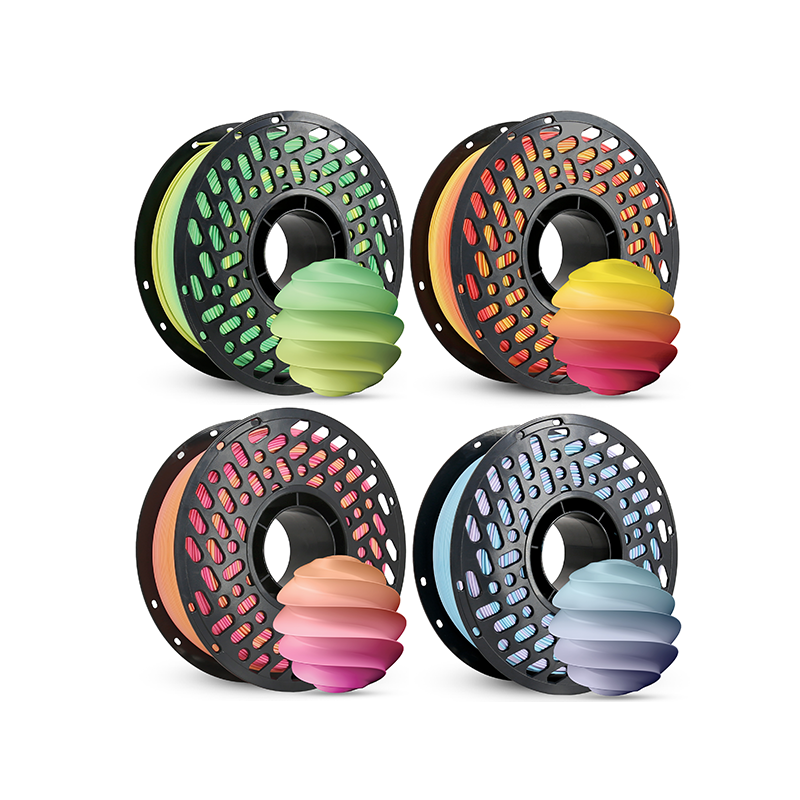
In multi-color FDM printing, controlling how long a color shift appears on a model is often linked to filament composition, spool winding pattern, and print settings such as extrusion rate. For users working with gradient materials, understanding how material behavior interacts with slicer parameters can help achieve more predictable visual outcomes in decorative prototypes and functional design samples. This type of material performance evaluation is also considered during filament development at CaiLab, where printing conditions are analyzed to better understand how formulation changes influence final appearance. Slicer preview tools help validate these effects before final printing. These considerations help bridge design intent and printing outcome.
Understanding Silk PLA Rainbow in Gradient Extrusion Behavior
The way gradient filaments behave during extrusion depends on how pigments are distributed along the spool and how quickly the filament is consumed. To control the visual transition length, users can first estimate the expected color change distance based on model height, print speed, and layer settings. Before printing a final model, creating a small calibration tower allows users to observe how quickly colors shift under different extrusion conditions.
When the printer maintains a stable flow, color segments stretch or compress based on speed and layer height. This makes initial calibration important for users aiming for consistent surface transitions in design-focused prints. This is particularly relevant when working with gradient-based PLA materials in design iterations process.
Print Speed Influence on Transition Length
One practical method to influence transition length is adjusting print speed. A slower extrusion rate can extend the visible color segment, while faster movement shortens it. Users experimenting with rainbow PLA filament often test different layer heights to observe how color bands compress or expand on curved surfaces, especially in decorative models with varying geometries. Nozzle temperature stability can further influence how smoothly the transition appears across layers. Users often document results to compare printing sessions later.
To create longer color transitions, users can reduce print speed because each layer consumes filament at a slower rate, allowing a single color segment to cover a larger model area. For shorter transitions, increasing print speed can help more colors appear within the same height range.
Slicer and Flow Parameter Control
Slicer settings such as retraction distance and flow rate also play a role in how color transitions appear. Users can adjust flow rate in small increments and compare the resulting color distribution through test prints. Keeping other parameters unchanged helps identify whether the transition difference comes from extrusion volume rather than model geometry.
Small changes in extrusion multiplier can shift the perceived length of each color segment. For designers working on visual prototypes, consistent parameter control helps maintain predictable results across multiple prints of similar models produced using CaiLab materials. Regular flow calibration helps reduce variation between prints and improves repeatability in batch production. This helps reduce unexpected variation across repeated experiments runs.
Layer Tuning Techniques for Rainbow PLA Filament Distribution
Layer height adjustments influence how quickly filament color changes become visible on the surface. A thicker layer may blend transitions, while thinner layers reveal more frequent shifts. Temperature stability also affects flow consistency, which indirectly impacts how gradient patterns are expressed in printed parts used by hobbyists and small production teams. Nozzle diameter selection may also subtly change how quickly color segments appear on curved geometries. These observations are useful for refining print strategies further.
For models requiring gradual color blending, users can select a smaller layer height to create smoother visual changes. When stronger color separation is preferred, increasing layer height may make each transition appear more noticeable. Testing different layer heights on the same model section can help determine the preferred effect before final printing.
Cooling Behavior and Material Response
Cooling settings can further refine the visual outcome when working with silk PLA rainbow materials. Faster cooling may preserve sharper color boundaries, while slower cooling can soften transitions between adjacent hues. Users can begin with a small calibration model and adjust fan speed gradually rather than changing multiple settings at the same time. This makes it easier to identify whether the transition effect is caused by cooling changes or extrusion behavior.
These adjustments are often tested in small calibration prints before scaling up to full design projects. Ambient printing environment, including airflow and chamber temperature, can also influence cooling behavior and final surface clarity. Environmental control often improves consistency in gradient output results in real practice.
Spool Consistency and Long Print Variation
Material flow consistency from spool winding can introduce variation in how color bands appear during printing. Some users notice that certain segments stretch more depending on extrusion tension. With rainbow PLA filament, these variations become more noticeable in tall models where continuous extrusion is required over long print durations. Long-duration prints may also reveal small inconsistencies in extrusion that are not visible in shorter test pieces. These factors are especially noticeable in long print jobs.
For tall models, users can estimate the expected transition distance before printing by checking the remaining filament length and planning the model orientation accordingly. Rotating the model or changing print height may help align important visual areas with preferred color transitions.
Geometry-Driven Color Perception
For users exploring decorative gradients, test prints remain essential to understand how design geometry interacts with material behavior. Curved surfaces, sharp edges, and varying infill densities can all alter how color transitions are perceived. Documenting each parameter change helps refine future iterations and reduces unpredictability in repeated production runs using CaiLab systems. Some users keep structured logs of slicer settings to compare results across multiple experimental runs. This approach reduces uncertainty during design iteration cycles workflows.
Calibration Workflow for Consistent Results
A structured calibration workflow often starts with small geometric samples such as cubes or cylinders. These models help users evaluate how color transitions behave under controlled conditions. Adjustments are then made step by step, focusing on one variable at a time, rather than changing multiple slicer parameters simultaneously. The filament combination set offered by CaiLab includes multi-color PLA options designed for testing gradient behavior in controlled environments. It also helps standardize testing across different filament batches.
Fine-Tuning Gradient Output in Practical Printing Scenarios
Achieving predictable color length control is usually a combination of slicer tuning, material behavior observation, and iterative testing. With rainbow PLA filament, users can refine their settings by tracking how each adjustment affects transition spacing across different model types. CaiLab materials provide a consistent base for repeated experimentation, allowing gradual improvement in print outcomes without abrupt changes in visual output. This supports more stable outcomes across multiple iterations processes. Digital slicer profiles and saved presets are commonly used to streamline iterative adjustments.
Conclusion: Balancing Settings and Material Behavior
Color transition length in gradient PLA printing is not controlled by a single parameter but by the interaction of speed, cooling, flow, and geometry. Users working with rainbow PLA filament can achieve more predictable results by building structured test routines and tracking each adjustment carefully. Over time, these controlled iterations help reduce variation and improve consistency in decorative model design and functional prototypes.